Reviewing Jupix CRM? Your website decision might be part of that.
No pressure, no hard sell
Jupix is a widely used CRM across UK estate and letting agencies.
For many, it works well operationally.
When it comes to the website, though, the setup varies.
Some agencies run a website that’s closely tied to Jupix.
Others use Jupix purely as their CRM, with a separate website alongside it.
The difference between those two setups becomes more important over time.
When your website is tied to your CRM
If your website sits inside your CRM setup, it usually works well - as long as nothing changes.
The friction tends to show up when:
That’s when the dependency becomes clear.
Because once your website is tied to one platform, making independent decisions becomes harder - and often more expensive.
If your website is tied to your CRM, that’s usually where the challenge starts.
If it isn’t, you’ve already solved part of the problem.
If your website is already separate
Then you’ve already avoided that dependency - which puts you in a strong position.
The question becomes:
Is your current platform giving you the flexibility, support, and ongoing development you actually need - or do changes start to feel more complicated than they should be?
Either way, the goal is the same:
A website that can evolve independently as your business changes.
This is where independence makes the difference
Whether you’re currently tied to your CRM or already separate from it, the goal is the same:
Your website should be the stable part of your setup - not something that has to change every time your back-office does.
Your website becomes the stable foundation.
Your back-office tools can evolve around it without disruption.
Jupix vs Estate Apps (clear differences)
| Area | Jupix Website | Estate Apps |
|---|---|---|
| Primary Focus | CRM platform with website capability | Independent website platform |
| Long-Term Flexibility | Aligned to Jupix workflows | CRM-agnostic and future-proof |
| Rebuild Risk | CRM change often triggers website change | CRM change does not force another rebuild |
| Platform Development | Driven by CRM priorities | Continuous website-led development |
| Third-Party Integrations | Primarily ecosystem-aligned | Open integration with ValPal, LeadPro, TwentyEA, ESTAS and more |
| Ongoing Relationship | Structured support model | Support included with regular strategic catch-ups |
Yes, it's a rebuild. That's the point.
We rebuild your website onto our independent platform.
That gives you:
Because we've done this many times, the migration is structured and managed carefully.
SEO and visibility are protected
A properly managed rebuild:
Visibility is protected - and often strengthened.
Built for estate agents, not adapted to them
Our platform is:
It isn't shaped by CRM roadmaps.
No long contracts
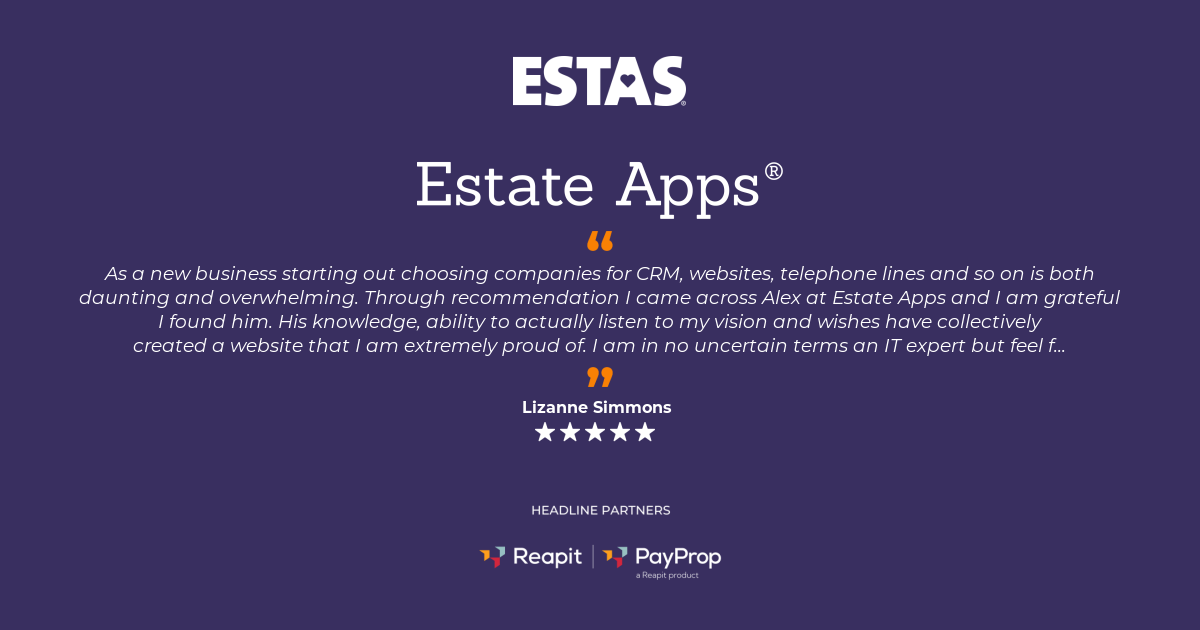
Don't just take our word for it



The takeaway
CRMs manage transactions.
Your website should manage growth.
If your website is tied to your CRM, that link will shape your future decisions.
If it isn’t, the question becomes whether your current platform is actually moving you forward.
Either way, if you’re starting to question your setup, it’s probably worth a quick second opinion.
Frequently asked questions
Straight answers to the questions agents usually have at this stage:
Do I need to change CRM to improve my website?
+No.
Many agents keep Jupix as their CRM and upgrade their website separately.
In fact, separating the two is often what gives you more flexibility long term - so one can change without affecting the other.
Why do Jupix websites often get replaced over time?
+It's rarely because the CRM stops working.
It's usually because the website needs to do more - and being tied to the CRM starts to limit what's possible.
That's when agents begin looking for a more flexible setup.
What happens if Jupix changes or is replaced?
+If your website is closely tied to it, you may need to revisit your website setup at the same time.
That's why many agencies choose to separate the two - so future changes don't force another big decision.
Will I lose my SEO if I switch?
+No - as long as the move is handled properly.
We manage redirects, structure, and tracking to protect your visibility.
In many cases, a more modern and actively maintained platform performs better over time.
Why rebuild instead of adapting the current site?
+Because adapting the existing setup usually keeps the same dependency in place.
A rebuild gives you a clean, flexible foundation that won't need revisiting later.
Will I still be able to update things myself?
+Yes - for the areas that actually need regular updates.
You can easily manage things like:
- Team profiles
- Blogs and area guides
- Reviews and testimonials
- Fees and key business information
And for anything outside of that, we handle it - so you're not left waiting.
How difficult is it to switch?
+Most agents expect it to be a headache.
In reality, it's usually much more straightforward than they think.
We handle the technical side, so the transition is smooth and disruption-free.
How quickly will I notice a difference?
+Usually quite quickly.
Most agents notice it in how easy things feel - faster updates, clearer support, and a site that starts moving forward again.
How do I know if it's worth switching?
+If things feel slower than they should, or harder than they need to be, it's usually worth a second look.
That's typically when agents reach out for a second opinion.
What actually improves once the website is separated from the CRM?
+The biggest difference is flexibility.
You're no longer working around one system - you're free to:
- Change CRM if needed
- Add new tools and integrations
- Keep improving the website without rebuilding it
That's what gives the setup long-term stability.
Something not quite adding up?
If your website feels harder to manage than it should - or like it’s not moving forward - there’s usually a reason.
And it’s usually worth understanding it properly before making your next move.
No pitch. No pressure.
Just a straight, honest second opinion.