 9 minute read posted by
 For years, the digital strategy for estate agents was beautifully simple.
Get more Google reviews.
Rank well in search.
Win more instructions.
And honestly? It generally worked brilliantly.
But the way people discover businesses online has shifted - and it's shifting fast. Search is no longer just about clicking a list of blue links. Increasingly, people ask questions and receive summarised answers directly from AI systems, search engines and voice assistants.
Those systems don't rely on a single source of information. They look across the entire web. And that's exactly why trust signals have become one of the most talked-about topics in marketing and SEO right now.
🎉 The good news? Most good estate agents already have them. They just haven't thought about them in this way before.
What are trust signals?
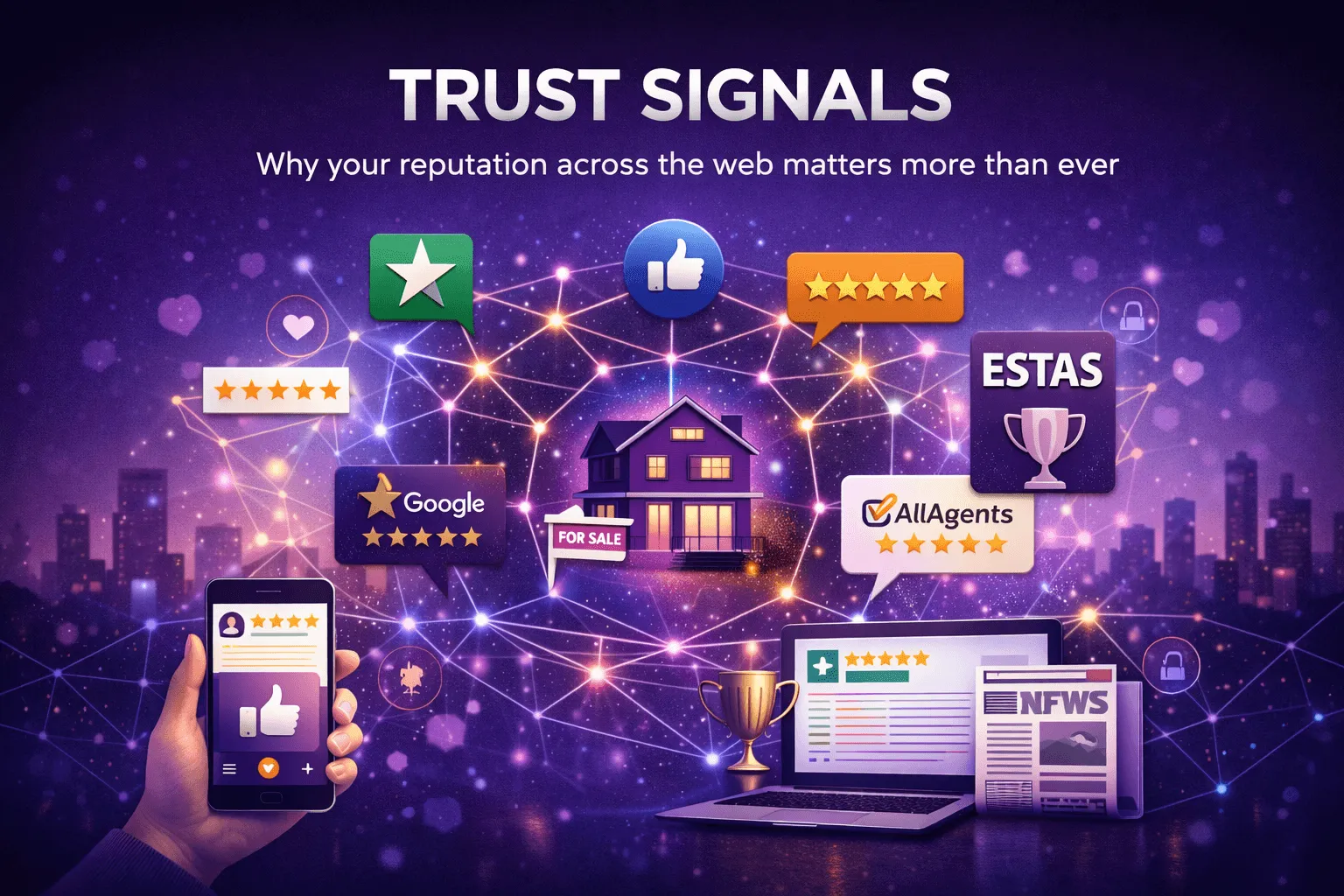
Trust signals are independent indicators that confirm your agency is credible, reliable and genuinely trusted. Think of them as the digital equivalent of word-of-mouth reputation - except instead of one neighbour recommending you over the fence, it's dozens of platforms, review sites and directories all quietly nodding in agreement.
Common trust signals include:
- Customer reviews (the lifeblood of local reputation)
- Industry awards and third-party accreditations
- Media mentions and press coverage
- Business directory listings (Yell, Google Business Profile, etc.)
- Consistent company information across the web (NAP: Name, Address, Phone)
- Your own website content - particularly helpful, experience-led articles like this one
When multiple independent sources confirm your reputation, it strengthens your credibility in the eyes of both search engines and AI systems. It's like everyone at the party vouching for you - search engines love a glowing crowd.
Where does the concept of trust signals come from?
This isn't a shiny new idea invented by a tech blogger at 2am. Google has been using reputation signals for years through its E-E-A-T framework:
Letter | What It Means |
E - Experience | Have you actually done this? Lived it, dealt with it, been there? First-hand knowledge counts. |
E - Expertise | Do you know your subject deeply? Credentials, track record, qualifications. |
A - Authoritativeness | Do others recognise you as an expert? External mentions, links, coverage. |
T - Trustworthiness | Are you consistent, transparent and reliable? The foundation everything else rests on. |
Google's own Search Quality Rater Guidelines instruct reviewers to check independent reputation sources when assessing a business. In other words: search engines don't just look at what you say about yourself. They look at what the rest of the internet says about you.
AI systems now follow exactly the same logic - and they're getting better at it every month.
Why trust signals matter in the age of AI search
Here's the clearest way to understand the shift that's happening:
Traditional Search Search → list of websites → user clicks through | AI-Powered Search Ask a question → receive a summarised answer |
To generate those summarised answers, AI systems pull from a wide range of sources:
- Publicly available web content
- Structured website data (schema markup)
- Independent review platform
- Large-scale web crawl datasets
This is why reputation distributed across multiple independent sources is becoming more valuable - not instead of your Google presence, but alongside it.
A lightbulb moment: our own realisation
Like many businesses, we invested heavily in Google Business Profile - and rightly so. Google reviews remain one of the most powerful conversion tools available to local businesses.
But when we started analysing how AI platforms summarise and describe businesses, something interesting emerged.
Many AI-generated summaries draw from a surprisingly broad range of sources: website content, independent review platforms, award listings, industry directories. Google reviews clearly influence rankings and buying decisions - but AI training data frequently leans on wider web sources too.
💡 Think of your Google presence as your anchor. Trust signals across the wider web are the tide that lifts the whole boat.
Where estate agent trust signals actually live
In the property industry, your reputation is typically spread across several different types of platform. Here's a practical breakdown:
Independent review platforms
These are the platforms that carry the most credibility precisely because they're not you saying how great you are.
They're widely referenced across the web and often appear in AI-generated summaries:
- Trustpilot
- AllAgents
- Feefo
- Reviews.co.uk
Pro tip: You don't necessarily need to be on all of them. Pick one or two and maintain them consistently - quality and recency matter more than spreading yourself thin.
Social platforms
Social media platforms - particularly Facebook - can also contribute to your reputation footprint. We know, we know: a bad review on Facebook feels personal. But disabling reviews entirely removes a visible trust signal from your profile.
The better play? Keep them active and moderate proactively. A professional, measured response to a negative review often does more for your credibility than 20 five-star reviews with no responses.
Industry awards
Awards are one of the most underused trust signals in estate agency. They're powerful because they offer independent, third-party validation that a neutral organisation has assessed your service and found it worthy of recognition.
The ESTAS are the most well-known in the UK property industry, but regional and local awards count too. The key is to link to the official award listing - not just pop a badge image on your website. A live link to an external award page is a verifiable trust signal. A badge image is just a badge image.
We integrated with the ESTAS review platform to help clients maximise the awareness and visibility of their hard work and it's completely automated.
Read more about why we integrated with ESTAS here.
Learn more about our Google Business Profile integration
Business directories
Not the most glamorous part of the strategy, but directories serve an important function: they confirm to search engines that your business exists, operates in a specific location, and has consistent contact details. Key players include Yell, Bing Places, Apple Maps, and local Chamber of Commerce listings.
⚠️ Common mistake: If your business name, address or phone number varies across different platforms, this inconsistency actively undermines your credibility signals. Check them regularly.
Why this matters commercially for estate agents
When a homeowner is deciding which estate agent to invite round for a valuation, there's always one question running in the background:
"Can I trust this company with the most valuable thing I own?"
Trust signals answer that question before you've even picked up the phone. When your agency appears consistently across reviews, award listings, directories and independent platforms, confidence builds fast - and the decision gets much easier.
That has a real commercial impact on:
- Valuation instructions (vendors choose you over competitors they know less about)
- Landlord decisions (they're trusting you with a significant asset)
- Brand credibility (you're the name people recommend at dinner parties)
- Referral likelihood (happy clients who can see your reputation are more likely to mention you)
- AI search visibility (the more credible sources reference you, the more likely AI is to include you in answers)
Your trust signal action checklist
If you want to strengthen your agency's digital reputation, start here. These aren't radical changes - they're small, consistent actions that compound over time.
- Keep building Google reviews
They remain one of the strongest conversion signals for local businesses. Make it easy for clients - a direct review link in a follow-up email goes a long way.
- Maintain at least one independent review platform
AllAgents, Trustpilot or Feefo are common in the property sector. Choose one and commit to it consistently.
- Keep Facebook reviews active
Moderate them rather than disabling them. A well-handled negative review is a trust signal in itself.
- Promote industry awards properly
Link to official award listings, not just badge images. The live link is what signals credibility to search engines.
- Audit your business information for consistency
Your Name, Address and Phone number (NAP) should be identical across every platform. Even small discrepancies matter.
- Create genuinely helpful content on your website
Blog posts, area guides and local market updates build E-E-A-T signals directly. If it's useful to a homeowner, it's useful to search engines too.
- Consider schema markup on your website
Structured data (LocalBusiness, Review, FAQPage) helps search engines and AI understand what your agency does and where. Worth discussing with your website provider.
The bigger shift happening online
Search engines used to rank websites. Increasingly, they evaluate entities and reputations. Your agency isn't just a URL anymore - it's a recognised entity that exists across multiple platforms, each one quietly contributing to how search engines and AI systems understand and describe you.
Reputation is built through three things:
- Consistency - the same story, told the same way, everywhere
- Corroboration - multiple independent sources saying the same thing
- Independent validation - third parties confirming what you claim about yourself
If your agency appears positively across multiple credible sources, you become much easier - and more likely - for search engines and AI systems to trust, reference and recommend.
Final thought
Trust signals aren't a new marketing trick someone invented last Tuesday.
They're simply the digital version of the reputation your agency has been building for years. The difference today is that search engines and AI systems are getting significantly better at finding that reputation, verifying it, and using it to decide who deserves to be recommended.
For estate agents who consistently deliver great service, that's genuinely exciting news.
Strong reputation leaves a trail. And the more places that trail appears, the harder it becomes to ignore. 🚀
📞 Book a no-nonsense chat with our team
Frequently asked questions
What are trust signals in SEO?
Trust signals are independent indicators - such as customer reviews, industry awards and directory listings - that confirm a business is credible and reputable online. They help both search engines and AI systems assess whether a business can be trusted.
Why are reviews important for estate agents?
Reviews influence both consumer decisions and online visibility. They act as social proof of service quality and help search engines and AI platforms understand the reputation of your agency. Recency, volume and consistency all matter.
Do Google reviews help with AI search results?
Google reviews still influence local rankings and user trust significantly. However, AI systems often draw from a broader range of sources - including independent review platforms, directories and website content - so a multi-platform approach to reputation is increasingly important.
What are the most important trust signals for estate agents?
The key signals are: customer reviews across multiple platforms, industry awards with live links to official listings, consistent business information (NAP) across all directories, helpful website content that demonstrates local expertise, and mentions or coverage in local or industry media.
What is E-E-A-T and why does it matter for estate agents?
E-E-A-T stands for Experience, Expertise, Authoritativeness and Trustworthiness - Google's framework for evaluating content and business credibility. For estate agents, it means demonstrating real local knowledge, consistent professional reputation, and third-party validation through reviews, awards and media mentions.



Share this with
Email
Facebook
Messenger
X
Pinterest
LinkedIn
Copy this link